
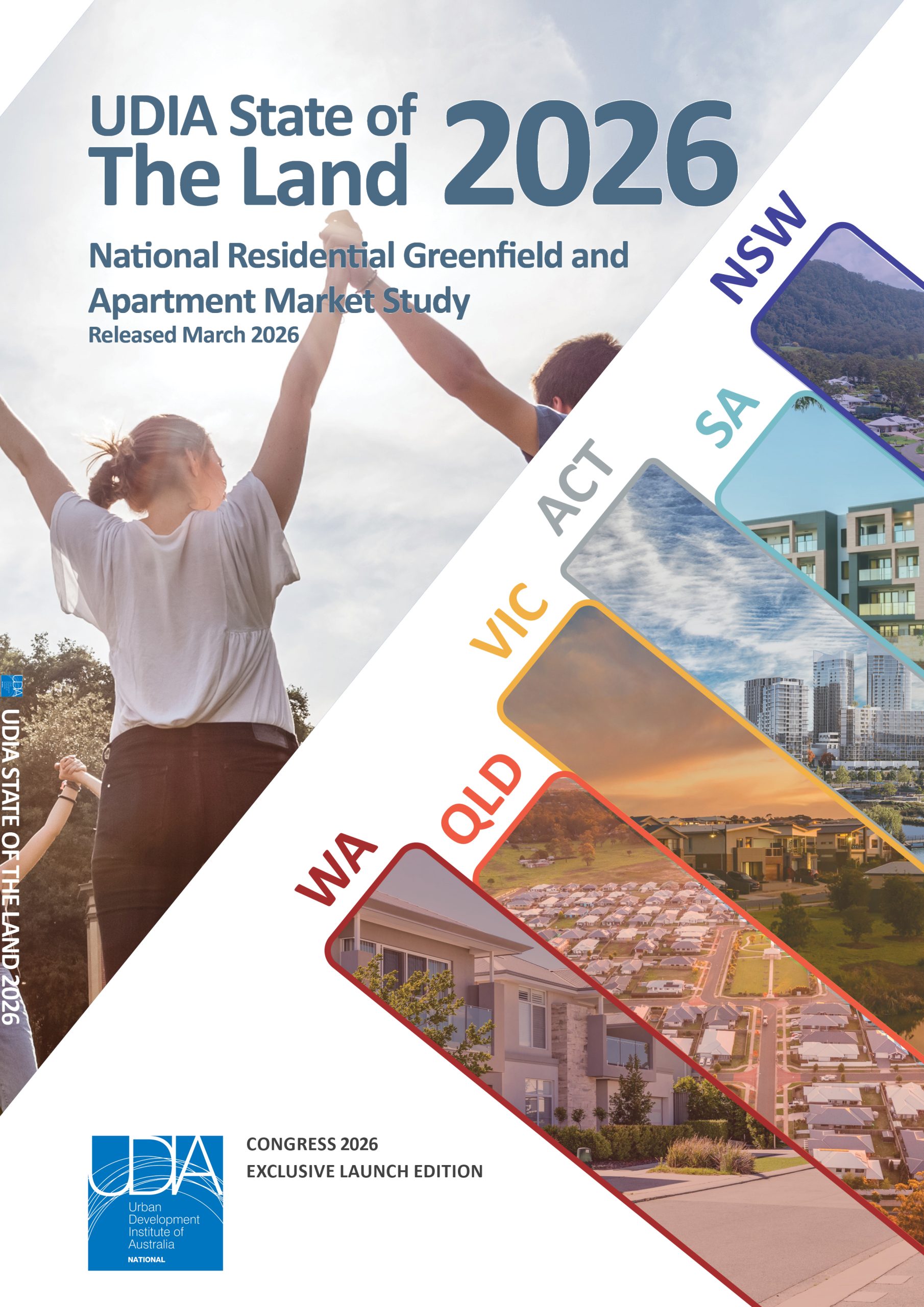
Australia’s housing crisis is set to deepen in the year ahead as the development sector continues to navigate a range of structural constraints including high construction costs, severe shortages of skilled labour, limited supplies of development-ready land and rising development holding costs, according to the UDIA State of the Land 2026 report.
The UDIA State of the Land (SOTL) 2026 , developed in partnership with Researchfour, Cotality and Charter Keck Cramer, is the most comprehensive annual assessment of residential development activity across Australia’s major capital cities providing industry, government and the broader community with a clear understanding of housing market dynamics, development pipelines and the economic forces shaping the delivery of new homes.
National President, Oscar Stanley, said the insights presented in this year’s report demonstrate the scale of the challenge ahead for governments across Australia which have committed to the ambitious goal of delivering 1.2 million new homes under the National Housing Accord by the end of the decade.
“UDIA’s current forecasts suggest new house and multi-unit supply across the major cities will remain materially below the levels required to meet the Accord target, leaving a significant cumulative shortfall over the coming years,” Mr Stanley said. “Our capital city housing markets recorded mixed fortunes in the past year, which highlights deep structural challenges facing the nation’s housing supply.”
UDIA National supports the foresight of Government-led housing targets, in that now Australia can properly track and measure supply boosting efforts which is crucial to getting the setting rights. The research shows there is likely to be a total national dwelling shortfall over the next five years of 380,000 homes. That number is equivalent to a deficit of about 76,000 new dwellings per year, which is roughly the size of Greater Cairns – annually.
Further, the SOTL found that Australia’s housing crisis is being intensified by a severe shortage of trading stock, with supply sitting at critically low levels in four of the six SOTL regions. This measure reflects the number of residential lots remaining unsold at the end of the December quarter, compared against historical benchmarks for what is considered a balanced market. Typically, a healthy market maintains between two and four months of active supply; however, several major markets are well below this range. Sydney and Adelaide both fall beneath this “robust trading band,” while the situation is considered much worse in Southeast Queensland and Perth, where active supply has dropped into what is considered as chronic or critically low territory.
On the plus side, new greenfield sales for detached houses did increase by 10% over the year, providing some welcome momentum in the land and detached housing market. That improvement was offset by a continued fall in new apartment and multi-unit transactions, which have now dropped to historically low levels across the country.
Despite the modest recovery in annual greenfield activity, overall capital city region lot sales remained 11% below the decade average, underscoring the persistent gap between housing demand and new supply. With strong population growth continuing to drive demand, the development sector is operating in what can best be described as a “strong demand/ constrained supply” environment.
The outlook for the apartment and multi-unit sector remains particularly concerning. Another year of subdued activity means this segment will continue to drag on overall housing supply – for at least the next three years. Even where planning approvals have begun to improve, the lengthy lag between approvals and project completions means the recovery in apartment construction will take far longer than the detached housing market.
Australia’s housing shortage has been building for decades. New dwelling construction has consistently undershot population growth for more than 20 years, leaving the country with a structural housing deficit that is now fuelling the rental and housing affordability crisis.
The latest forecasts indicate new dwelling production will fall by a further 11% in 2026, a trend that will continue to place additional upward pressure on housing prices and rents across all residential product types. The new UDIA report highlights an urgent need for coordinated policy reform to address these barriers and unlock new housing supply.
“Our industry has the capacity to build the homes Australians need,” Mr Stanley added. “What is required now is decisive action from governments to ensure the right conditions are in place; including increasing development-ready land supply and delivering coordinated infrastructure, so the sector can deliver the affordable homes that Australians urgently need.”
Read the full report, with state and territory statistical breakdowns, here: https://udia.test.slickdesign.au/research-insights/state-of-the-land/