
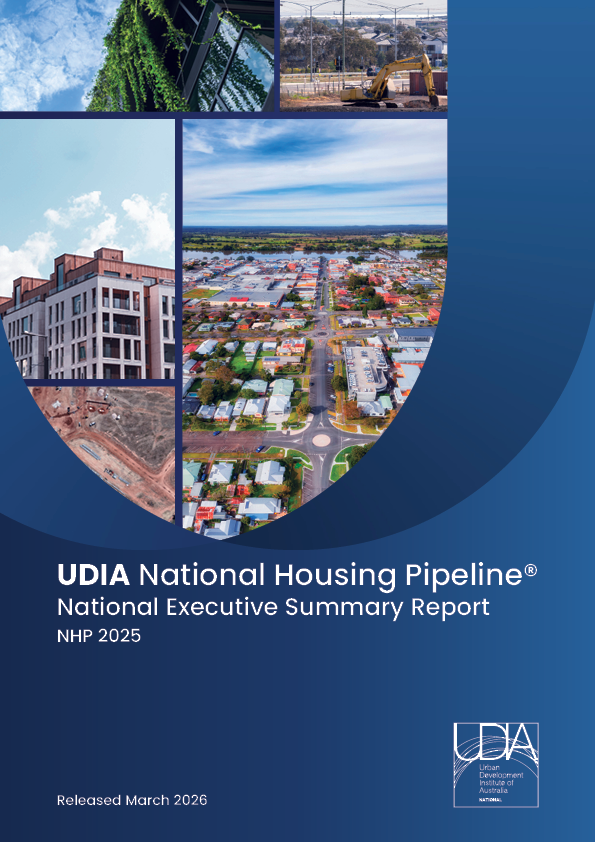
The Urban Development Institute of Australia (UDIA) has released its National Housing Pipeline® (NHP) Technical Report which reveals 40 per cent of all zoned land for new housing is either environmentally or infrastructure constrained and where the barriers are located.
These roadblocks are pushing down Australia’s five-year dwelling production pipeline by more than 380,000 homes against the National Housing Accord target and recent supply shocks are making it worse.
Escalating fuel costs have already added $10,000-$20,000 more to housing costs as it impacts everything from excavation and asphalt production to PVC piping and materials production.
“As supply chain shocks bite into industry capacity and project viability, the only way forward is unlocking more housing projects held up by environmental and infrastructure barriers to bolster supply – the NHP is a roadmap for combatting housing shortfalls and market shocks,” said UDIA National President, Oscar Stanley.
Already the NHP is being used by Governments to stress test, inform and prioritise infrastructure across states and territories, to unlock supply for more viable housing projects.
The latest Australian Bureau of Statistics (ABS) data shows housing is the largest contributor to the Consumer Price Index (CPI), rising 7.2% in February, emphasising the compounding pressures from the dwelling supply gap and ongoing cost escalations.
The NHP reveals that no matter the Accord target and Government housing initiatives, the market will continue to flounder until the removal of infrastructure limitations, servicing gaps, social infrastructure deficits and provision of sensible environmental overlays.
“Forty per cent of all undeveloped housing supply is constrained by barriers which in many cases simply stop housing construction dead in its tracks,” said Mr Stanley. “However, the good news, is many of the barriers are solvable and the NHP provides a literal spatial roadmap of what these problems are and where Government needs to focus effort.
“The UDIA National Housing Pipeline® shows exactly where supply will stall, why it stalls and what needs to change. In effect, it is the country’s plan of attack for restoring housing supply.”
The UDIA report; the most comprehensive, development-industry-vetted assessment of land supply and dwelling delivery capacity in the nation, shows that net completions across the combined NHP Capital City regions are forecast to miss the new home supply target by at least 32% confirming that Australia’s housing challenge is no longer theoretical – it is measurable and increasingly urgent.
Mr Stanley said the shortfall persists despite modest strengthening in greenfield feasibility in some corridors.
“It reflects systemic delivery constraints, not a lack of industry intent, innovation or willingness to build,” he said. “The NHP combines geospatial land supply auditing, a detailed developer intension’s survey, technical workshops and cross-jurisdiction engagement to present a clear picture of what can be delivered, where and when. Importantly, it distinguishes between theoretical and deliverable land supply.”
Some of the NHP’s key findings are:
- Greater Sydney Megaregion – 34% of surveyed greenfield yield requires commitment/funding for infrastructure
- Greater Melbourne/Geelong – 15,944 hectares of undeveloped unconstrained residential zoned land
- Southeast Queensland – 44% of surveyed greenfield yield requires commitment/funding for infrastructure
- Greater Perth – 5.96 years of unconstrained residential land supply National Housing Accord annual dwelling target rate
- Greater Adelaide – 31% of NHP surveyed yield requires commitment/funding for enabling infrastructure
“The foresight of Government’s housing targets is that now Australia can properly track and measure our supply boosting efforts – that is vital to getting the settings right. The NHP has a pivotal role in uncovering the type, location and severity of housing barriers,” Mr Stanley added.
Across all reporting regions, approximately 40 per cent of undeveloped residentially zoned land is constrained by environmental overlays, infrastructure limitations, servicing gaps, social infrastructure deficits or other factors that either sterilise development potential or materially delay delivery.
“In practical terms, not all zoned land is development-ready land,” Mr Stanley said. “Government forecasts often reflect theoretical capacity because commercially sensitive developer insight on feasibility, servicing status and realistic approval timeframes is not available to decision-makers.”
The NHP Developer Intentions Survey confirms that infrastructure timing and funding commitments are among the most powerful determinants of when homes are built.
Infrastructure sequencing remains the single largest delivery gate. In particular, trunk water and sewer infrastructure are the most prevalent bottlenecks across the country. Regional and state road infrastructure is the second largest constraint, representing hundreds of thousands of dwellings whose timing is linked to government investment decisions and coordination settings.
Recent initiatives demonstrate what is possible. The Federal Government’s agreement with the South Australian Government under its 100,000 First Home Buyer Program is the first large-scale initiative to directly combat the infrastructure funding gap through a combination of loans for water infrastructure, urban renewal grants and matched State funding. The agreement is expected to unlock 17,000 new homes across South Australia, including almost 7,000 for first home buyers.
“Infill and apartment markets remain essential components of a balanced housing system but Greenfield housing supply is Australia’s most scalable and lowest per-dwelling cost pathway to increasing total output in the short to medium term,” Mr Stanley added.
Environmental approvals are another significant delivery delay factor. The 2025 NHP survey reveals that 28 per cent of total survey supply requires environmental or biodiversity approvals to proceed. 17 per cent requires Federal environmental approvals, and 43 per cent of those approvals involve offset requirements. There is broad industry support for robust environmental outcomes. Predictability and coordination, not deregulation, are the key reform levers.
“The UDIA NHP has been delivering a critical convergence over the past year between industry and government in recognising the true nature of the constraints,” Mr Stanley said. “There is now greater acknowledgement that not all zoned land is deliverable land; that infrastructure sequencing and funding models materially shape outcomes and that approval system complexity has cumulative impacts.”
UDIA will continue to work collaboratively with Federal, State and Local Governments to prioritise enabling infrastructure investment in development-ready corridors, streamline and coordinate approval pathways, improve transparency around real land readiness, support feasibility recovery in the infill sector and bring more projects into the critical intersection of zoned, serviced and financeable development-ready supply.
“Our findings are clear,” Mr Stanley said. “Without coordinated infrastructure investment, environmental approval reform and a pragmatic approach to unlocking scalable greenfield supply, national housing targets will remain out of reach. The opportunity to correct course remains within our grasp, but only if policy and investment settings focus on what can genuinely be delivered, not simply what is theoretically possible.”
Read the National Housing Pipeline® (NHP) Technical Report here: https://udia.test.slickdesign.au/research-insights/nhp/